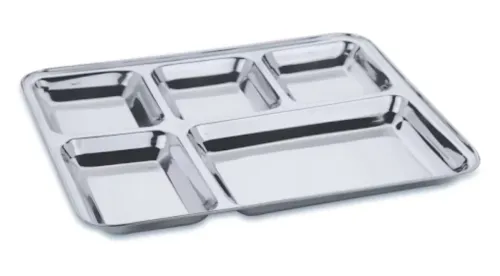
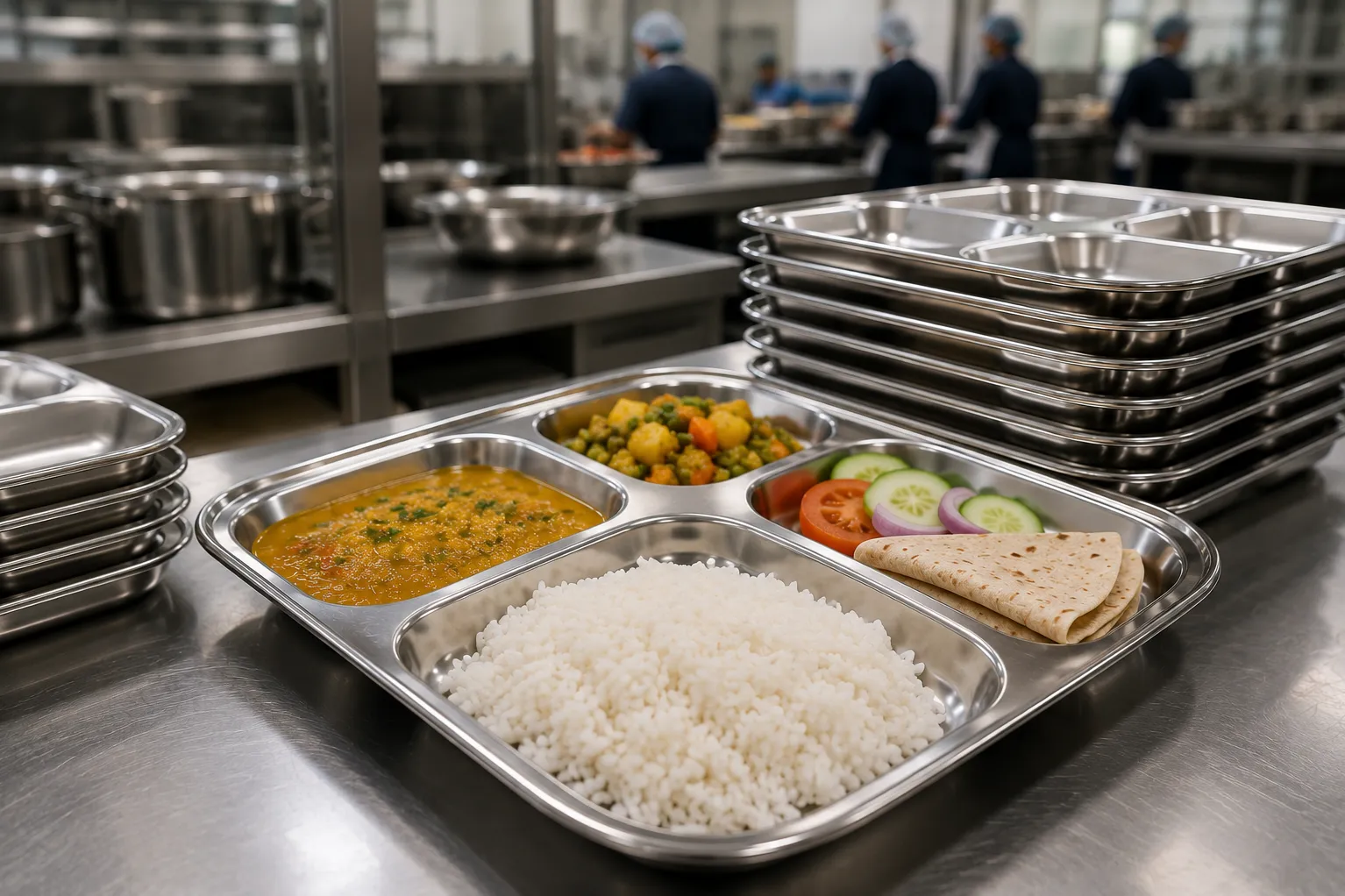
Compartment plates used in schools, hospitals, hostels, temples, factory canteens, and catering operations must handle far more wear than ordinary household utensils. They are filled, carried, stacked, washed, and reused several times each day. A plate that looks suitable in a catalogue may prove inconvenient when introduced into a high-volume dining environment.
Choosing a dependable Stainless Steel Compartment Plate Manufacturer requires buyers to evaluate meal suitability, construction, safety, washing convenience, and order consistency.
Does the Layout Match Your Menu?
The number of sections should be based on the meals being served, not simply on appearance. A breakfast menu may need one large section and a few smaller portions, while a complete lunch may require separate spaces for rice, roti, vegetables, dal, curd, and salad.
Sections intended for liquid foods should be sufficiently deep to reduce mixing while the plate is carried. At the same time, excessive divisions can make portions too small and increase cleaning time.
Test a sample with a complete meal before approving the design. This allows serving staff and users to identify layout problems that may not be visible when the plate is empty.
Is the Plate Suitable for Repeated Handling?
An excessively thin plate may bend, dent, or become unstable. A very heavy design can make serving, carrying, and washing tiring when hundreds of meals are handled daily.
Check the plate’s:
- Overall weight and balance
- Material specification
- Strength under normal pressure
- Stability on a dining table
- Resistance to bending
- Shape after repeated stacking
The most suitable option should offer sufficient strength without creating unnecessary handling difficulties.
Are the Edges and Compartments Safely Finished?
Inspect the outer rim, internal sections, corners, and base. Every surface that users or cleaning staff may touch should be smooth and properly finished.
Reject samples showing:
- Sharp or unfinished edges
- Rough internal corners
- Visible cracks or weak joints
- Uneven polishing
- Raised or unstable bases
- Gaps where food may accumulate
Safe finishing is especially important when plates will be used by children, patients, senior citizens, or large groups.
Can the Plates Be Washed and Stored Efficiently?
Deep grooves and narrow corners can retain food residue and increase cleaning time. Rounded sections are generally easier to wash and inspect.
Stack several plates together to confirm that they separate easily. Plates that become tightly locked can slow meal service, while unstable stacks may create storage and handling risks.
If commercial dishwashing equipment is used, verify that the plate dimensions fit the existing racks and washing system.
Will the Bulk Order Match the Sample?
Before production, document the approved size, number of sections, weight, finish, dimensions, and packaging method. Buyers should also ask whether the same specifications can be maintained for future orders.
For larger quantities, inspect random pieces from different cartons before accepting the complete delivery.
ADKRAFT INDIA supports compartment plate requirements for institutional kitchens, canteens, hostels, healthcare facilities, catering operations, and community dining programmes. Share your menu, serving volume, preferred layout, quantity, and washing method to identify a plate suited to daily operations.
Keywords