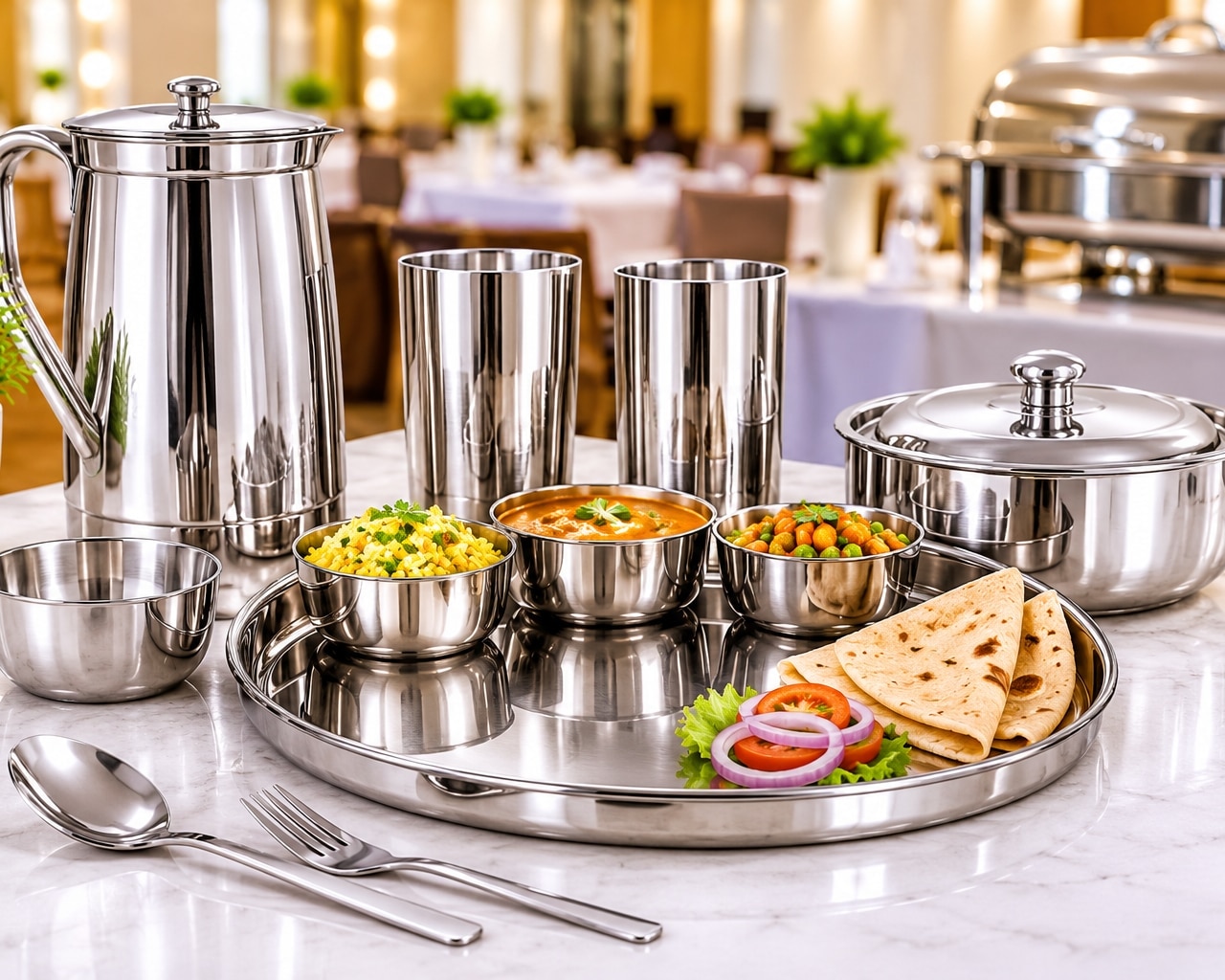
The right tableware specification depends on service format, washing capacity, menu, storage space and replacement needs—not simply the number of pieces in a set. Use the guidance below to compare plates, bowls, thalis, serving items and supplier terms before committing to a bulk order.
Key takeaways
- Use complete sets for repeated place settings; buy individual pieces for changing menus.
- Check the steel grade, gauge, welds, rolled edges and finish before approving samples.
- Test washing, stacking, dent resistance and food-service handling before placing a bulk order.
- Add replacement stock and agree quantities, lead times, defects and delivery terms in writing.
Choose the Tableware Format for Each Service
Use complete dinner sets only where the same place setting repeats; buy individual pieces where service changes by meal, menu or breakage rate. Breakfast usually needs plates, bowls, tumblers and spoons that move quickly through washing. Banquets benefit from matching individual pieces, while buffets need extra serving dishes and replenishment stock.
Caterers need stackable, transport-friendly formats rather than unnecessary set components.
| Format | Best fit | Specify |
|---|---|---|
| Full dinner set | Fixed restaurant menus and standard hotel room service | Exact plate, bowl, spoon, tumbler and lid contents; nesting method |
| Individual plates and bowls | Breakfast, banquets and high-volume restaurants | Separate quantities for dinner plates, side plates, bowls, tumblers and spoons |
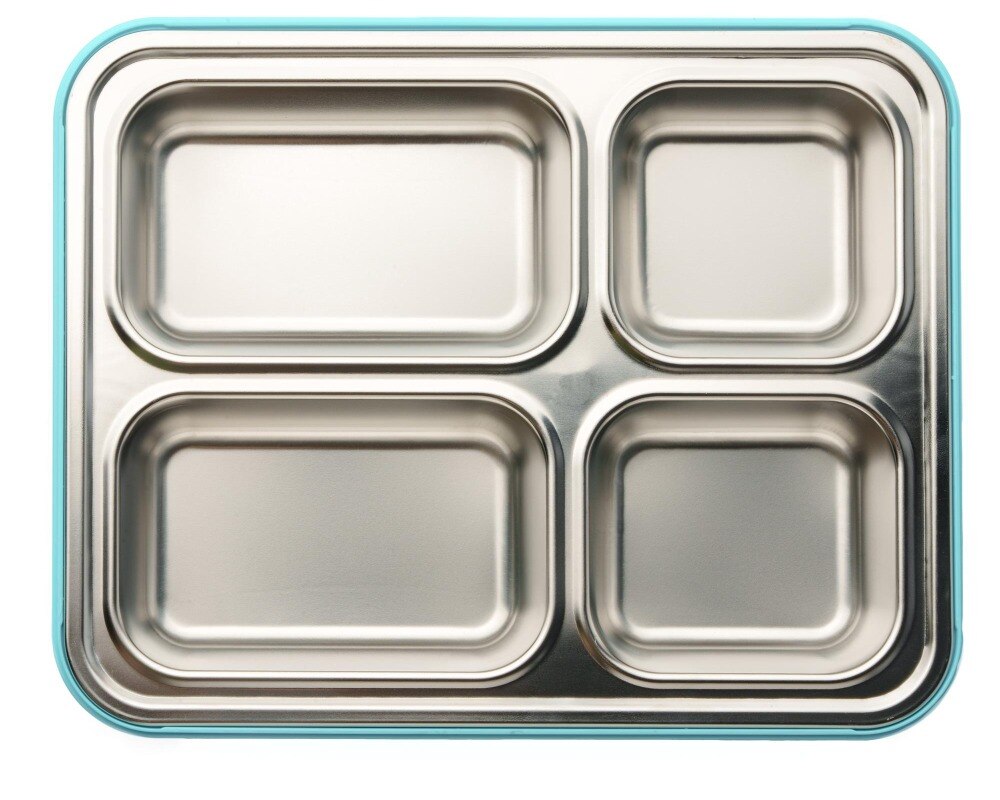
| Thali set | South Indian meals, staff dining and portioned restaurant service | Tray diameter, compartment count, katori count and each bowl capacity |
| Compartment plate | Buffets, cafeterias and fast service | Compartment sizes, rim depth, stack height and compatibility with trays |
| Serving items | Buffets, banquets and catering lines | Handi, serving bowl, ladle, tong and platter sizes; matching replacements |
Ask a restaurant thali set supplier to quote every component separately; a “six-piece” set can count the tray and katoris in different ways. For steel dinner sets for hotels restaurants and caterers in bangalore, specify replacement plates, bowls and tumblers alongside the opening order.
- Choose sets for consistency, individual pieces for flexible menus, thalis for portioned meals, and serving ware for shared food.
- Confirm identical replacement availability, carton quantities and nesting before approving a mixed format.
- For catering, prioritise stackability, secure transport and quick sorting over decorative pieces.
Set Practical Dimensions, Capacities and Weights
Specify usable capacity, finished weight and millimetre thickness in the purchase order; “six-piece set” is not enough. A supplier can count the tray, katoris, spoon, tumbler and lids differently, creating an apparent saving that fails at service.
| Service | Recommended specification | Target finished weight |
|---|---|---|
| Breakfast | 25–27 cm plate; 150–200 ml bowl; 8–10 mm rolled rim | Plate 350–500 g; bowl 180–280 g |
| Main meal | 28–30 cm plate; 250–350 ml bowl; 10–12 mm rolled rim | Plate 500–700 g; bowl 250–400 g |
| Thali | 28–32 cm tray; four to six compartments; 150–250 ml katoris | Tray 500–800 g; each katori 120–220 g |
| Catering | 26–28 cm stackable plate; 200–300 ml bowl; 10–15 mm reinforced rim | Plate 450–650 g; bowl 220–350 g |
Use 0.8–1.0 mm minimum finished thickness for plates and thali trays, and 0.7–0.9 mm for bowls. State where thickness is measured, because a quoted gauge can mean sheet thickness, a supplier’s convention or marketing language.
For steel plates and bowls wholesale, approve one physical sample and record diameter, usable depth, weight, flatness and stack height. Require the quotation to list tray diameter, bowl count and capacity, spoon length, tumbler capacity, lids, individual or nested packing, weight tolerance of ±5%, and replacement-piece availability.
Thin items increase denting, sorting time and mixed-table settings.
Verify Stainless-Steel Grade and Manufacturing Quality
Compare the claimed grade with chemical identification and a written thickness specification, not with price or a magnet. In stainless steel dinner set wholesale in bangalore, state the grade, minimum thickness in millimetres at named locations, finished-weight tolerance and sample quantity in the purchase order.
| Grade | What the claim means | How to verify |
|---|---|---|
| 304/304L | Austenitic stainless steel with approximately 18% chromium and 8% nickel; common for food-service contact | Request grade documentation; use handheld XRF or laboratory analysis for disputed lots |
| 202 | Austenitic chromium-manganese steel with less nickel than 304; usually a cost-driven choice | Do not accept “food-grade” as proof of 304 |
| 430 | Nickel-free ferritic stainless steel with lower corrosion resistance; magnetic | Confirm the grade chemically rather than relying only on magnet response |
A magnet cannot approve or reject a lot: cold-worked 304 can attract it, while 202 and 430 can also produce misleading results. Inspect cartons across the production run, not only the showroom sample.
- Hold each plate on a flat surface and check rocking, bowing and uneven bases.
- Run a clean finger around rolled rims; reject sharp edges, open seams and trapped polishing compound.
- Examine deep-drawn bowls and plates at the shoulder and base for thinning, hairline cracks and wrinkles.
- Reject exposed welds, pinholes, dents that prevent stacking, and deep scratches.
- View polishing under angled light; reject swirl marks, cloudy patches and inconsistent shine that conceal surface damage.
Record acceptable dent, scratch, weld, polish and dimensional tolerances before dispatch. A visually attractive sample does not prove that the bulk lot used the same material or forming settings.
Test Samples Before Approving a Bulk Lot
Approve each sample only after it passes a working trial, not visual inspection alone. Build a representative stack of plates and bowls, place it in the actual dishwashing rack, and measure stack height, clearance and fit before signing with a hotel tableware bulk supplier.
| Test | Method | Reject if |
|---|---|---|
| Nesting | Stack the maximum intended quantity and lift it by the top piece | Pieces lock together, retain water, or separate with force |
| Rack fit | Run loaded racks through the machine and check spray arms, conveyor guides and storage shelves | A rim touches equipment, blocks spray, or the rack will not slide freely |
| Stability | Place bowls and thalis in their normal rack slots, then move and unload the rack | Foot rings rock, pieces tip, or compartments catch neighbouring items |
| Tray fit | Load the largest planned combination on service and catering trays | Items overhang, collide, or leave too little grip space |
Run samples through the commercial wash cycle, then inspect rolled edges, flatness, welds and finish for distortion, dull patches or rust-coloured transfer. Test stains and odours with tea, turmeric, tomato gravy and salty food; wash correctly and reject pieces that retain smell or colour.
Expose samples to the hottest planned service and wash conditions, then check for warping, loosened attachments and heat-discoloured areas. Do not soak stainless steel in bleach or hypochlorite, use concentrated chloride cleaner, or scrub it with carbon-steel wool; these practices can cause pitting and iron contamination.
Record each sample’s weight, diameter, usable depth and stack height for comparison with the delivered lot.
Calculate Quantities, Replacements and Supplier Terms
Buy against peak simultaneous covers, not your total seating capacity. Multiply covers by the number of turns needed before washing returns the item: 180 covers needing two turns requires 360 pieces; add 15% make-up stock and round to a pack size, giving 414 pieces, or 420 if cartons contain 20.
Keep higher reserve for items that disappear fastest, such as bowls, spoons and tumblers.
Secure these terms from a hotel tableware bulk supplier:
- Exact component quantities: list every plate, bowl, spoon, tumbler, lid and tray separately. A restaurant thali set supplier must state each bowl’s capacity, tray diameter and packing method, not only “six-piece set.”
- Replenishment lead time, minimum reorder quantity, carton quantity, identical replacement availability and the period for which the design will remain available.
- Transit-risk responsibility, breakage and shortage reporting deadlines, product warranty, and free replacement procedure. State that replacements must match the approved batch.
- Purchase-order tolerances: minimum thickness in millimetres at named locations, permitted weight variation, dimensional limits, and acceptable dent, scratch, weld and polish defects. Specify how many pieces the supplier will sample.
- Inspection timing, carton markings, invoice batch numbers, stainless-steel grade, material declaration or food-contact test document, and batch traceability.
For stainless steel dinner set wholesale in Bangalore, put these details in the purchase order rather than relying on a catalogue description. ADKRAFT INDIA can be assessed by the same written checklist, which makes quotes comparable and exposes mixed lots before delivery.
Frequently asked questions
When should a hotel buy complete steel dinner sets instead of individual pieces?
Buy complete sets when the same plate, bowl, tumbler and spoon combination repeats across service. Choose individual pieces when menus, meal periods or breakage rates differ.
Which stainless-steel details should restaurants verify before buying in bulk?
Verify the stated steel grade, sheet thickness or gauge, rolled edges, weld quality, surface finish, dimensional consistency and resistance to dents, stains and corrosion.
How should a caterer test steel tableware samples?
Run samples through normal washing, stacking and handling routines, then check for warping, sharp edges, dents, water marks, finish changes and inconsistent dimensions.
How many replacement pieces should a bulk buyer order?
Base the quantity on peak simultaneous covers, washing turnaround, menu-specific demand, breakage and the time required for the supplier to replenish rejected or damaged pieces.
Keywords